
The Flight Bag Essentials: What Professional Pilots Actually Carry
Nov 9, 2026 · 7 min read
If you're starting your pilot career in the United States, you probably already have an idea of what you need to fly: a headset, charts, checklists, documents, fuel, and, of course, an aircraft.
But as you progress from your first flight hours toward your Instrument Rating and eventually your Commercial Pilot Certificate, something starts to change.
Your flight bag stops being just a bag where you keep your things.
It becomes a tool for the job.
And while every pilot develops their own preferences, there are certain items you'll find again and again in the flight bags of professional pilots.
So, what does a pilot actually carry?
In this article, we'll look at the flight bag essentials that can help you stay prepared, organized, and focused as you progress through your aviation career.
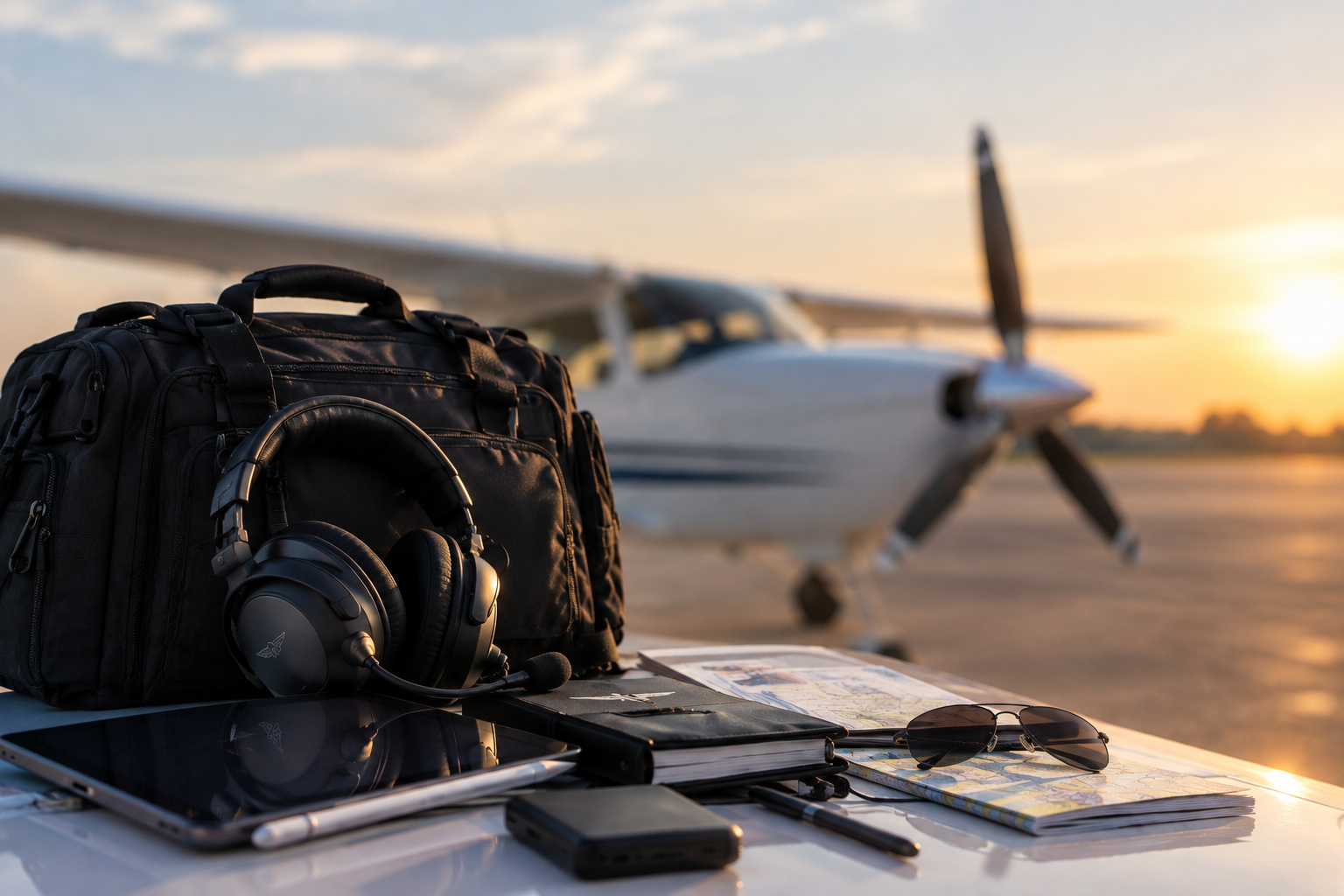
1. A Reliable Flight Bag
Before we talk about what's inside, you need a good bag.
You don't necessarily need the most expensive flight bag on the market. What matters is that it's:
- Durable
- Comfortable to carry
- Easy to organize
- Compact enough for your operation
- Capable of protecting your electronic devices
A good flight bag should allow you to quickly find what you need.
Because when you're preparing for a flight, organization means efficiency.
Over time, you'll discover which items you actually use on every flight and which ones simply take up space.
Your goal shouldn't be to carry more.
It should be to carry the right things.
2. Headset
Your headset will probably be one of the most important investments you make as a pilot.
A good headset allows you to communicate clearly, reduce cockpit noise, and stay comfortable throughout the flight.
When you're just starting out, it can be tempting to use a headset provided by your flight school.
But as you build more flight hours, having your own headset can become a valuable investment.
Especially if you plan to spend hundreds of hours inside an aircraft.
When choosing a headset, some important factors to consider include:
- Comfort during long flights
- Microphone quality
- Noise reduction
- Durability
- Aircraft compatibility
- Battery life, if applicable
You don't necessarily need to buy the most advanced model from day one.
But it's worth thinking of your headset as a piece of equipment you'll use throughout a significant part of your aviation career.
3. iPad or EFB
Technology has significantly changed the way pilots prepare for and manage flights.
For many pilots today, an Electronic Flight Bag (EFB) has become an essential tool.
A tablet can be used to access charts, aeronautical information, procedures, flight planning tools, and other resources needed for flight operations.
But having an iPad or tablet in your flight bag doesn't mean you should become completely dependent on it.
A professional pilot needs to understand the information they're using and know what to do if an electronic device stops working.
That's why the most important thing isn't the device itself.
It's developing the habit to:
Know your equipment. Know your procedures. Have a backup.
4. EFB Mount or Kneeboard
Once you start using a tablet during flight, you also need to think about how to keep it accessible.
Depending on the aircraft and your preferences, you might use:
- Kneeboard
- Tablet mount
- Flight clipboard
- Yoke mount, when appropriate and permitted
The goal is simple:
Keep your information accessible without creating a distraction.
A good setup should allow you to quickly reference information without interfering with the aircraft's controls, instruments, or procedures.
5. Backup Power
One of the easiest problems to avoid is arriving at the airport with a device that's almost out of battery.
Your tablet can be an incredibly useful tool.
Until it runs out of power.
That's why many pilots keep a portable battery or power bank in their flight bag.
You may also want to carry:
- Charging cables
- Adapters
- Spare batteries, when necessary
- A compatible aircraft charger, when applicable
You don't need to turn your flight bag into a portable power station.
You simply need to make sure your essential devices can remain operational throughout the flight.
6. Sunglasses
Sunglasses aren't just an accessory.
Exposure to sunlight can contribute to eye fatigue and make flying less comfortable.
For pilots, high-quality sunglasses that provide clear vision and reduce glare without unnecessarily distorting colors are generally preferable.
This is especially important in aviation.
So when choosing sunglasses for flying, think less about fashion and more about:
Clarity, comfort, and functionality.
7. Aviation Documents
Depending on your stage of training and the operation you're conducting, you'll need access to different documents and credentials.
For example, a pilot may need to carry or have available items such as:
- Pilot certificate
- Government-issued photo ID
- Medical certificate, when applicable
- Logbook
- Aircraft documents or operational information, depending on the operation
The exact requirements depend on the type of operation and the applicable regulations.
That's why you shouldn't assume that the same checklist works for every pilot.
Know what your operation requires.
And, most importantly, keep your documents organized and easy to access.
8. Logbook
Your logbook is much more than a record of the hours you've flown.
It's the history of your training and experience as a pilot.
As you progress from your PPL to Instrument, CPL, and eventually toward a professional aviation career, maintaining accurate records becomes increasingly important.
Today, many pilots use digital logbooks, while others still keep a physical logbook as a backup.
What matters isn't only where you record your flights.
It's that your records are:
Accurate. Consistent. Organized.
Never underestimate the value of maintaining your logbook properly from the beginning of your career.
9. Pilot Kneeboard and Pen
It may seem like a small thing.
But having a place to quickly write down information can be extremely useful.
A kneeboard can help you organize:
- ATIS information
- Frequencies
- Clearances
- Flight notes
- Weather information
- Checklists or quick references
And here's another item that many pilots still carry even in a cockpit filled with technology:
A pen.
Actually, probably more than one.
Because when you need to write something down, discovering that your only pen doesn't work is an entirely avoidable problem.
10. Flashlight
A small flashlight takes up very little space and can be extremely useful.
Even if you normally fly during the day, a flashlight can become an important tool if conditions change or if you need to inspect something in a poorly lit area.
Many pilots also carry a small backup light.
As a general rule:
Small, reliable, and easy to access.
You don't need a huge flashlight.
You need one that works when you need it.
11. Water and Small Snacks
Flights and training days can be longer than you initially expect.
Staying hydrated and having something light to eat can help you stay comfortable and focused.
You don't need to turn your flight bag into a camping backpack.
Simply consider carrying:
- Water
- Small snacks
- Gum or mints, if you prefer
Especially when you're building flight hours, you may spend many hours at the airport or complete multiple flights in a single day.
Being prepared also means taking care of your basic needs.
12. Spare Headset Accessories and Cables
As you fly more, you'll start to discover that a few small accessories can save you from unnecessary problems.
Depending on your equipment, you might carry:
- Spare headset batteries
- Audio adapters
- Charging cables
- Connector adapters
- A small electronics pouch
You don't need to carry every adapter ever made.
But it's worth identifying the small items that could leave you without an important tool during a flight if they fail or are forgotten.
13. A Physical Backup
Technology is incredible.
But aviation also teaches you an important rule:
Always have a backup for critical equipment.
That doesn't mean you need to carry a second version of absolutely everything.
It means understanding which tools are critical to your operation and knowing what you would do if one of them stopped working.
Your backup could be as simple as:
- A portable battery
- An appropriate secondary navigation resource
- Backup charts or information when required
- A second flashlight
- An alternative way to access essential information
The philosophy is more important than the object:
Don't let one failure become your entire plan.
14. What You Probably Don't Need
A professional flight bag shouldn't become a collection of gadgets.
It's easy to fall into the idea that you need every accessory you see on social media.
But more equipment doesn't necessarily make you a better pilot.
Before adding something to your flight bag, ask yourself:
Do I actually use this?
Does it improve my operation?
Does it solve a real problem?
What happens if it fails?
If you can't answer those questions, you probably don't need to carry it.
Your Flight Bag Will Evolve With You
One of the interesting things about starting a career in aviation is that your equipment evolves with you.
When you're working toward your PPL, your flight bag will probably be relatively simple.
Then comes the Instrument Rating.
You start using more flight-planning tools.
Then comes the CPL.
You start thinking less like a student and more like a professional pilot.
Eventually, as you build hundreds of hours of experience, your flight bag will reflect your own needs and preferences.
There is no single perfect flight bag.
There is the one that works for you, your aircraft, and your operation.
The Professional Pilot Mindset
At the end of the day, a flight bag doesn't define a pilot.
You can have the best headset, the latest iPad, and every accessory available and still have a lot to learn.
What really matters is what you do with the tools you have.
Preparation.
Organization.
Discipline.
The ability to anticipate problems.
And the responsibility to know your procedures and limitations.
Because becoming a professional pilot doesn't happen when you buy your first headset.
Or when you fill your first flight bag.
It starts much earlier.
It starts when you decide to take your training seriously.
Ready for the Next Step in Your Pilot Journey?
If you're currently working toward your Private Pilot Certificate, Instrument Rating, or Commercial Pilot Certificate, every flight is another opportunity to build experience and develop the habits that will shape your career.
At EnvySky Aviation, pilots can continue their training through programs designed to support their progression from foundational training toward professional aviation, including:
- Private Pilot
- Instrument Rating
- Commercial Pilot
- Multi-Engine
Whether you're preparing for your first solo, working toward your CPL, or thinking about the experience you'll need after earning your commercial certificate, your professional journey starts with the habits you build today.
Your pilot journey starts here.