
CFI vs. Paid Time Building: Costs, Time & Career Progress in 2026
Oct 28, 2026 · 3 min read
Costs, time, and where you could be in 30 months.
You have your commercial certificate. Now compare the full path: money invested, time spent, experience gained, and when your next paycheck could start.
The quick answer
- Choose CFI If you enjoy teaching and want to earn while building hours—approximately 2 years. Strengthen your technical knowledge, communication, and leadership while helping students develop. Allow time to complete your instructor training, find a teaching position, and build your student schedule. Your pace depends on you, your students, and the school you work with.
- Choose dedicated time building
If you can fund your flying and want to prioritize consistent progress approximately 7 months. Build experience through cross-country trips, night flying, route planning, and practical decision-making alongside other qualified pilots. Develop teamwork, adaptability, and the ability to learn from different perspectives while positioning yourself for airline opportunities sooner—with the potential to begin recovering your training and time-building investment earlier. Your pace depends on you, your provider, aircraft availability, and flying conditions.
- Compare the whole timeline: training, job search, flying, hiring, and potential investment recovery.
Two routes. One career decision.
- What does each route cost?
- How soon could you reach your hour target?
- What could starting your next job earlier change?
The video and charts use illustrative timelines and hiring assumptions. They are planning scenarios, not typical results or guarantees.

Look beyond the hourly rate.
- EnvySky example: $65,000 for 1,000 shared hours, including fuel and oil under the package terms.
- CFI example: $10,000–$15,000 budgeted for instructor qualifications, followed by paid instruction.
- Same starting point: 500 hours. Starting at 250? Budget another 250 hours beyond that package.
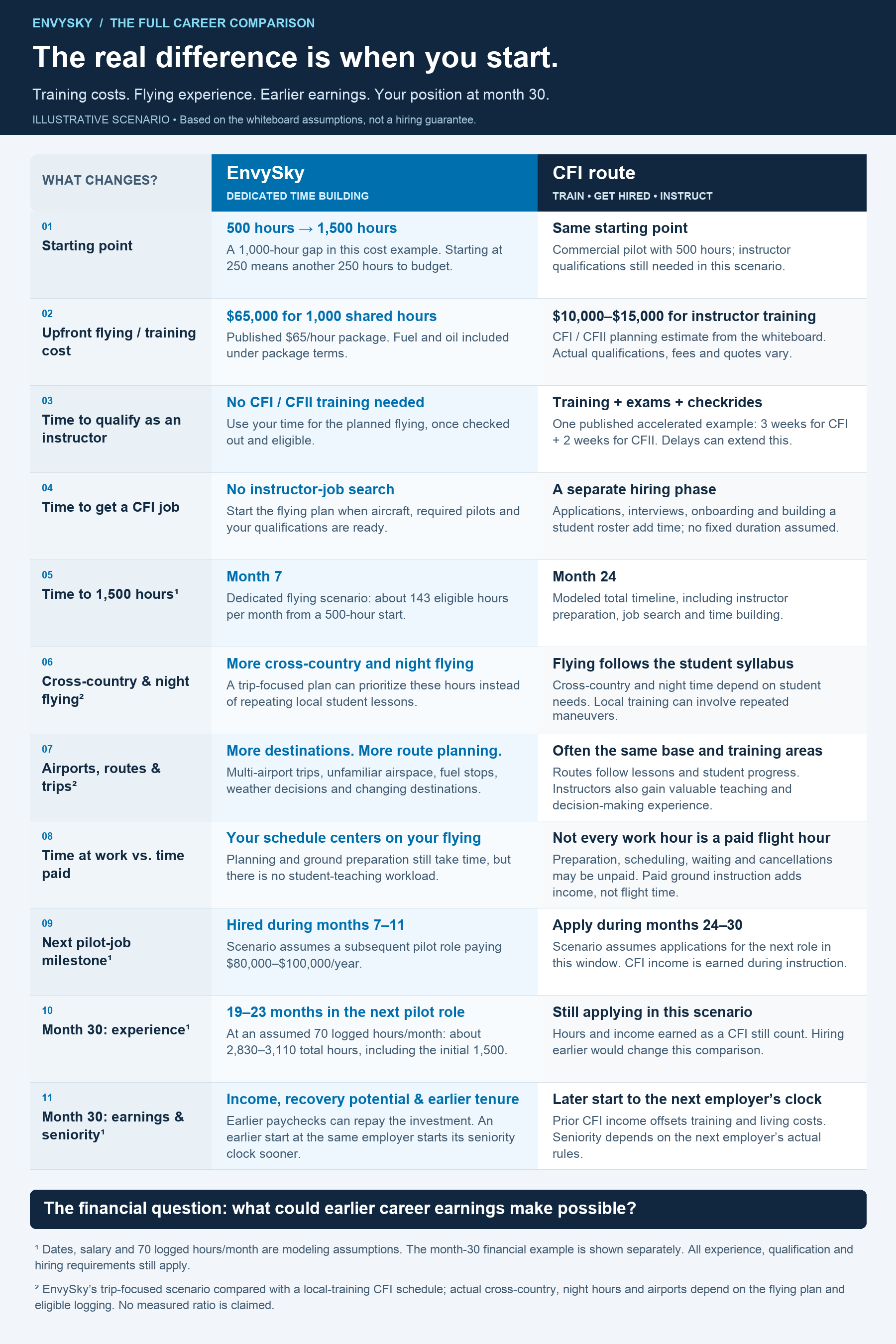
Illustrative timelines and salaries follow the stated scenario; actual progress varies.
Getting paid to fly starts before the first lesson
- Get qualified: training, written exam,s and checkrides. One accelerated school advertises three weeks for CFI plus two for CFII; completion can take longer.
- Get hired: applications, interviews, onboarding, and building a student roster add time.
- Count the whole day: lesson preparation, student coordination, waiting and cancellations may include unpaid time.
- Separate pay from flight time: ground instruction may be paid, but it does not add flight hours.
Illustrative workweek
40 hours committed · 20 flight hours · 5 paid ground hours · 15 unpaid hours.
At $30 per paid hour: $750 earned, or $18.75 per hour of total time. Actual pay arrangements vary.
More routes. More destinations. Purposeful flying.
A trip-focused EnvySky plan can provide more cross-country and night flying than a CFI schedule centered on local student lessons.
- Cross-country: longer routes, navigation and fuel planning.
- Night: plan eligible flights around the experience you need.
- Different airports: new approaches, unfamiliar airspace and ATC environments.
- Real trips: multi-stop itineraries, weather decisions and changing destinations.
The mix depends on your route plan and logging eligibility. CFI work also develops teaching, judgment, and communication skills, and can include cross-country and night flying.
Earlier earnings can help offset your investment.
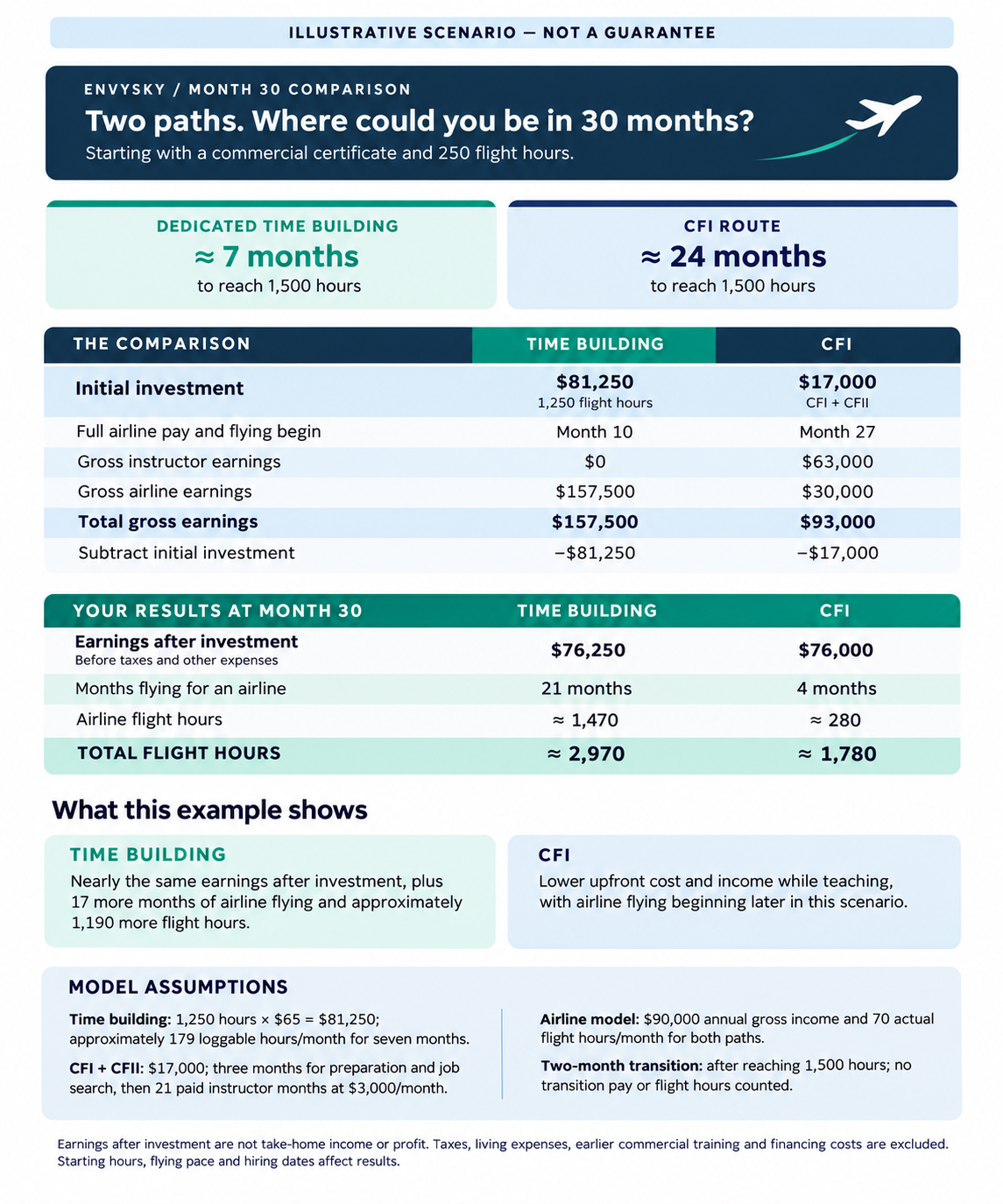
Worked example: Invest $81,250 in 1,250 flight hours and begin airline flying in month 10 at $90,000 annually.
By month 30:
- Earnings: $157,500 gross, or $76,250 after the time-building investment, before taxes and other expenses.
- Experience: 21 months of airline flying and approximately 2,970 total hours, assuming 70 logged hours per month.
- Seniority: An earlier start can establish an earlier seniority date at that airline.
Illustrative assumptions, not guaranteed results or full investment recovery.
Build your plan around your starting point.
Send us your current hours, certificates, target, and available dates.
- Review the hours you still need.
- Confirm package costs and aircraft availability.
- Plan suitable routes and a realistic schedule.
Explore packages & request your plan →
Before booking, confirm eligible logging, all additional cost,s and the qualifications for your next role. Reaching 1,500 total hours alone does not establish ATP eligibility or guarantee employment.
Sources and planning assumptions
Timelines, hiring windo,ws and salaries are illustrative inputs from the EnvySky video. Package pricing: EnvySky time building. Accelerated CFI/CFII example: Skybound Aviation. Instructor pay considerations: LA Flight School and Thrust Flight. ATP requirements: 14 CFR §61.159 and §61.160.